AI Automation · 10/12/2026
Daily AI News Digest
A self-hosted n8n pipeline on Dokploy that reads RSS feeds from Hacker News, arXiv cs.AI, Hugging Face, and OpenAI, combines and prepares their items, summarizes them with Gemini, and delivers a daily digest through Telegram. It runs at 09:00 and also has a manual test trigger.
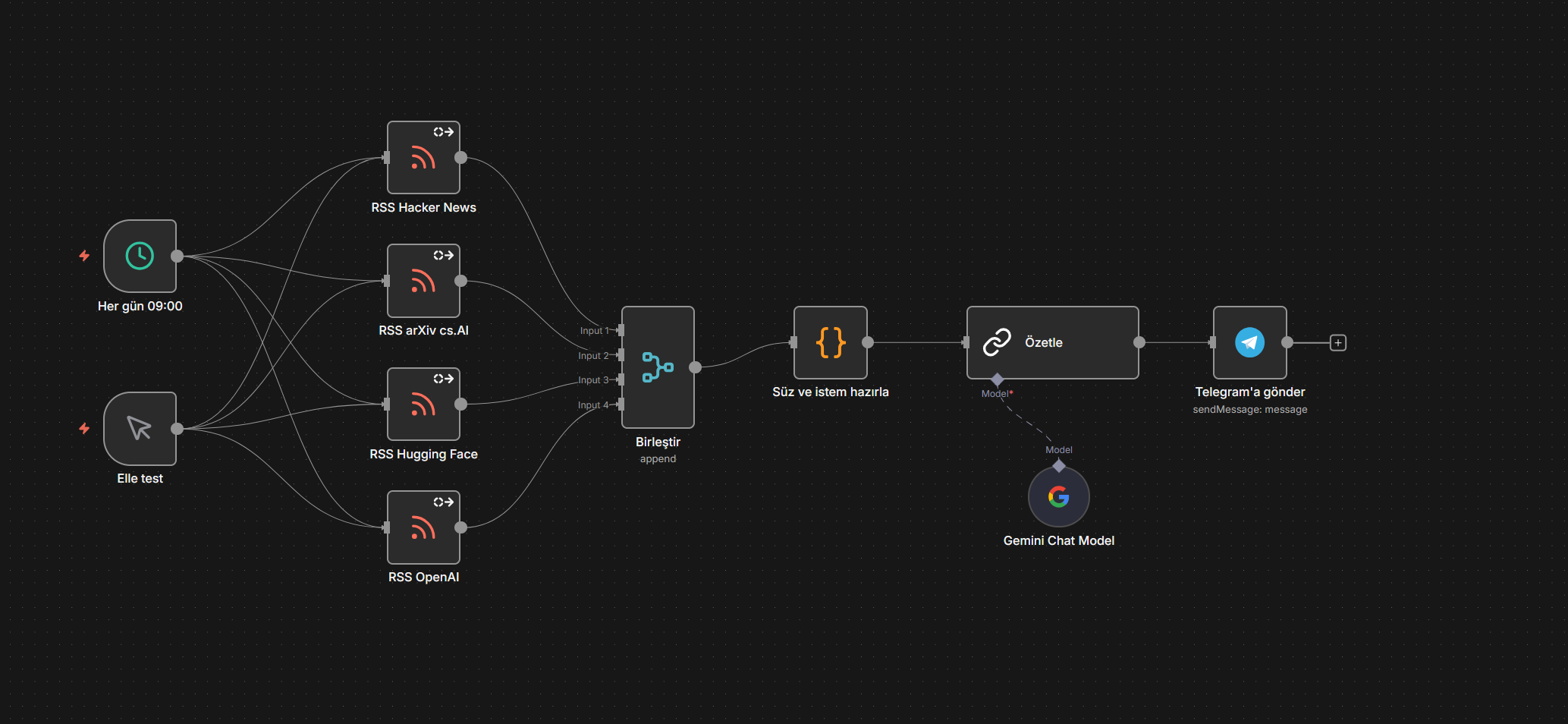
This project is a small, self-hosted news pipeline: separate source readers collect feed items, a preparation step shapes them for an AI summary, and a Telegram node delivers the result. The workflow runs in n8n on my Dokploy server.
Sources and input
The workflow has one RSS reader for each source:
- Hacker News — technology stories and discussions from its feed.
- arXiv cs.AI — research papers published in the artificial intelligence category.
- Hugging Face — updates exposed through its RSS feed.
- OpenAI — updates exposed through OpenAI’s RSS feed.
Each reader contributes feed items to the same processing path. The diagram shows RSS ingestion; it does not show a separate crawler that opens and reads each linked article. The digest is therefore based on the information available to the workflow from those feeds and the preparation step.
Processing pipeline
- Trigger: a Schedule Trigger starts the workflow every day at 09:00. A Manual Trigger provides a second entry point for testing. Both lead into the source and processing path.
- Collect: the four RSS nodes read their configured feeds independently.
- Merge: the Merge node uses append mode to bring the incoming feed items into one stream. This keeps the source readers separate while giving the next step a combined input.
- Prepare: the Code node named “Süz ve istem hazırla” applies the workflow’s configured selection and formatting logic, then prepares the prompt for the summarization step. Keeping this work in one node makes the prompt and item-selection rules easy to inspect and adjust.
- Summarize: the “Özetle” step uses the connected Gemini Chat Model to turn the prepared input into a concise digest.
- Deliver: Telegram’s sendMessage operation sends the generated summary to the configured chat.
Runtime and boundaries
The schedule and manual trigger share the same downstream workflow, so a test run exercises the same collection, preparation, summarization, and delivery stages as the daily run. The current diagram shows four RSS inputs, one append merge, one Code preparation step, Gemini summarization, and Telegram delivery. It does not show a database, a website crawler, or a review step before sending.
RSS feed items and the prepared prompt are passed to Gemini for summarization; the result is then sent to Telegram. The workflow diagram above documents these components and their connections.